

Why Design Thinking Isn't Enough
How a serendipity practice brings humanity back into the process

Design Thinking is a human-centered, iterative approach to problem-solving that focuses on understanding user needs, challenging assumptions, and redefining problems to create actionable, innovative solutions.1
It promised to democratize innovation and has been a go-to method for designers and strategists worldwide for decades. In recent years, however, design thinking has faced considerable criticism. Skeptics challenge whether it has lived up to its potential—including IDEO, the firm credited with making it famous.2 Getting to the core of what went wrong and what we should do next remains murky.
Mauro Porcini, Chief Design Officer at Samsung (and before that PepsiCo and 3M), summarized the problem with design thinking this way:
“The design community made huge promises in the first decade of this new millennium about the power of design thinking, and then in many instances, design thinking didn’t deliver.
Design thinking is important because you need a methodology, you need a process, you need tools, exactly like a painter needs a brush. But then you need the right painter. You need Picasso, because if you give that brush to Picasso, you get something. If you give that brush to my accountant or my kid, you’re going to get something different.
Instead, our design community talked too much about the brush, the bristles, the material, and how to design the brush. We forgot that, at the end of the day, what really makes the difference is the thinking of the design thinkers.”3
He’s right. Too much has been said about the brush, and not enough has been said about the thinkers.
So how do we consider the thinkers—us, the humans—and how can we bring our unique value into the process the way we’d bring an agenda, inspiration, user insights, and sticky notes into a working session?
First, we let go of the idea that executing a repeatable, linear process will produce outsized, non-linear outcomes on its own. The process isn't the solution; we need to stop expecting it to do the work for us.
Second, we focus on what we can bring to the process that it can’t provide. This includes non-linear inputs, individual inspiration, past experiences, creativity, and our gut feelings.
How do we do this? How can we become builders, creators, and contributors and not just executors and repeaters?
Bring the practice of serendipity into our work.
One of our greatest human characteristics is our ability to adapt—to bend, flex, respond, react, learn and create when we encounter the unexpected and the unknown. In order to do this, we need aspects of our lives and our work that are out of our control, and then we need a means and a method of working with these things to create outsized value.
This is serendipity. A practice of working with the unexpected: creating the conditions for it, seeing it, connecting it, and acting on it to create value. It’s a flywheel of mindsets and behaviors. The practice is four moves, each feeding the next:
Expand what you’re exposed to (Seek & Encounter)
Capture what’s new or interesting (Collect)
See patterns and opportunities before they crystallize (Connect)
Act while others are still analyzing, iterate while they’re considering (Pursue & Create)
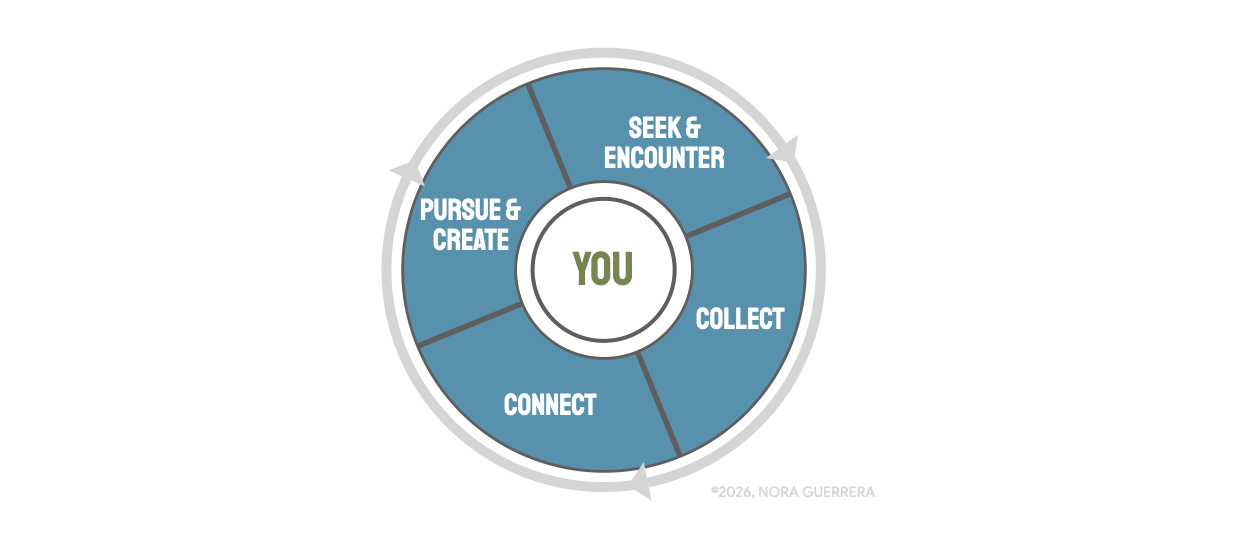
The steps are not linear, they overlap, support and build on one another. They are a starting point and a framework for creating. When something you create is strong enough, it spins out, while your practice continues. There’s always something new to encounter, a new insight waiting to inspire you and a new connection to build from.
In closing:
A process can be run by anyone, and increasingly, it can be run by AI. What can’t be automated is the moment you notice something unexpected, recognize it as potentially valuable, and do something about it. This is serendipity.
Building and running a serendipity practice alongside linear processes like Design Thinking, Design Sprints, and strategy sessions allows you to move beyond just executing the method. Instead, you become the variable that goes beyond the obvious to reach exponential outcomes.
To use Porcini’s analogy, if design thinking gives you the brush, a serendipity practice makes you the painter. Ready to pick it up? Start here: Practice Serendipity.
Related Reads:
The Triple Diamond: What Happens After the End of the Design Thinking Double Diamond
The Future of Design Thinking: Moving Beyond Magic to Long-Term Relevance
Harvard Business Review: What is Design Thinking and Why is it Important?
Learn more about its origins here: https://www.designcouncil.org.uk/our-resources/the-double-diamond/
IDEO responds to criticism of design thinking:
https://designthinking.ideo.com/
https://mastersofscale.com/a-first-look-at-samsungs-blueprint-to-win-the-ai-era/