

Vineyard Vines
Serendipity isn't luck, it's a loop. A Serendipity Story.
Serendipity Stories bring the practice of serendipity to life in real-world examples.
In the summer of 1998, two brothers were selling neckties on Martha’s Vineyard — off their boat, out of a backpack, out of the back of a Jeep, anywhere they could find a customer. It was a strange thing to be selling. Across the country, the necktie was disappearing. Offices were going casual, the tech industry had made the open collar a status symbol, and Steve Jobs had retired the suit entirely in favor of a black turtleneck. By every reasonable measure, Shep and Ian Murray had bet their savings, their credit, and their careers on a dying product.
They had not arrived there by accident, though. After college, both had landed entry-level jobs in New York — Shep in advertising, Ian in public relations — and both had found the work hollow. Underneath the dissatisfaction was something more useful than complaint. Ian, especially, couldn’t stop noticing how things might be done better: how a shop greeted its customers, how a product was packaged, what small change would have made an ordinary moment land differently. Wherever the brothers went, they were quietly taking inventory of the world, looking for opportunity.
What they noticed, again and again, was that the most exciting businesses of the moment were built on overlooked things. Tom First and Tom Scott had turned a roadside fruit-juice stand into Nantucket Nectars. Howard Schultz had made a cup of coffee into Starbucks. The fishmongers at Seattle’s Pike Place Market had turned the sale of a salmon into a piece of theater. None of these were new inventions. They were ordinary things, reimagined by people who had paid attention, saw an opportunity, and were willing to try something new. The Murrays found that idea magnetic.
Every day, Shep and Ian would meet for lunch to commiserate, “How was your day? It sucked. How was your day? It sucked. When are you going to quit? When are you going to quit?” was the ongoing conversation.
During this time, Shep began turning over an idea in his mind. It grew out of childhood memories the brothers had from spending summers on Martha’s Vineyard, and the island had always been special to them — a particular pace, a particular freedom, a relaxed vibe. It also drew on something only two reluctant tie-wearers would notice: the necktie market had a hole in it. Beautiful printed ties from houses like Hermès cost well over $100 at the time. Novelty ties cost $25 or $30 and looked it. Between those two extremes, there was nothing.
A family trip to Anguilla turned the loose pieces into a plan. While there, Shep floated the necktie idea to Ian, and as the brothers talked it through, it sharpened into something specific: a well-made silk tie, priced in the empty middle of the market, printed with the imagery of the place they loved — tiny whales, sailboats, the hand-lettered town signs of Martha’s Vineyard. A tie, in other words, that said something about the person wearing it. As the idea formed, their excitement grew. They told the resort manager, who handed them a New York City phone book and told them to start calling manufacturers. They did.
Neither brother knew anything about making clothing, but they dove in, learning it firsthand, piece by piece, spending their lunch breaks tracking down silk importers, label makers, and stitchers, one introduction leading to the next, all while keeping their day jobs. They financed the first production run — 800 ties — with an $8,000 cash advance on their credit cards. In May of 1998, frightened and certain in equal measure, they quit. Then they went to the island to sell.
The selling taught them what the planning could not. The first sale was a jolt of pure validation — a small Vineyard shop bought $1,800 worth of ties on the spot, a staggering sum to two founders living on credit cards. Another key lesson came from a store called Murray's (no relation), which moved some of its stock to a sister shop on Nantucket, where the ties sold twice as fast. The idea that their ties could extend beyond a single island was unexpected, but it encouraged the brothers to dream bigger — an accident, noticed and turned into a direction.
The same instinct showed up again that August, when President Bill Clinton, embroiled in a personal scandal, arrived on Martha's Vineyard for an escape — and brought every major news network with him. Most people saw a media circus. Ian saw possibility. He draped a dozen ties around his neck, biked over to the press camp, and worked the parking lot until Vineyard Vines ties turned up on national broadcasts that night. The brothers hadn't planned for a presidential scandal. But they saw the opening, and they went for it.
With this momentum, the brothers kept listening and learning, doing whatever it took to grow their business. During one sales road trip up the Eastern Seaboard, they walked into a well-regarded Boston men's store. The owner more or less laughed at these two inexperienced kids and their ties in plastic sleeves, then made them a wager: if he won a game of backgammon, they'd take their ties back and never bother him again; if they won, he'd take some on consignment. Ian played him and won — and that was the start of a long, good relationship with the store.
In other instances, when a store owner said no or “maybe”, the brothers' approach was to simply keep showing up — hanging around those stores, stocking shelves, helping sell on the floor. This earned them the owners' respect, and they eventually gave them a chance. Additionally, by being on the floor, they were learning the business itself: what shoppers responded to, how the trade actually worked — invaluable insights.
The same loop ran through everything: an openness to whatever they encountered, a habit of collecting it, an instinct for connecting it into something useful, and the will to act before the moment passed. It shaped their work with partners and suppliers, too. When one supplier suggested they make boxer shorts with their signature prints, the brothers initially said no. The supplier made it anyway and showed them the sample; they instantly changed their minds. Customers kept asking for more, and the brothers kept saying yes: tote bags, polo shirts, dresses. Their tie company became a brand.
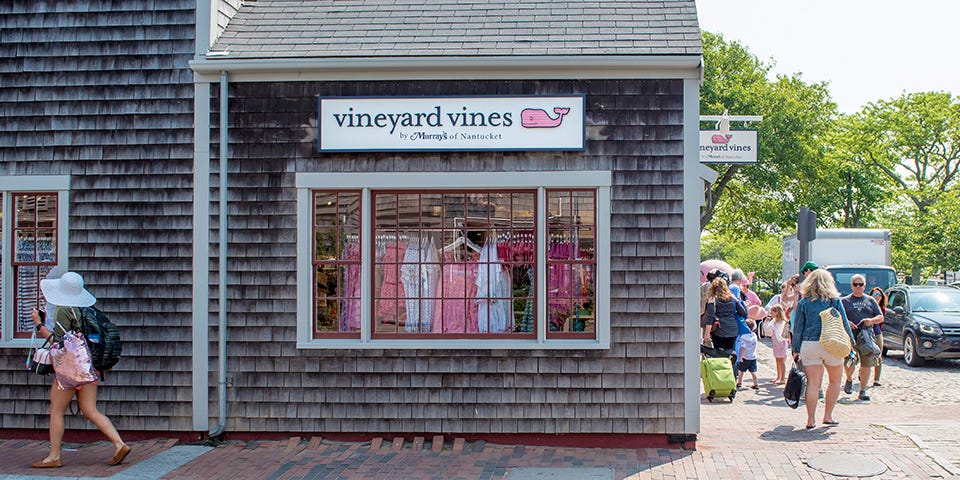
Today, Vineyard Vines does roughly half a billion dollars in sales a year, has more than 100 stores and shelves in major retailers, and is still owned and run by Ian and Shep.
The success of Vineyard Vines isn't the result of a linear plan or a predetermined outcome. The fact that it even exists at all is the result of a way of moving through the world: staying open, noticing what others don't, gathering up pieces that didn't yet fit, and then — when those pieces finally connect — making the decision to act. That sequence is the practice. Seek and encounter. Collect. Connect. Pursue. The Murrays didn't get lucky — they ran that loop again and again. And none of it was out of reach. You can run the same loop. Keep your eyes out for a frustration, an unexpected insight, a fragment of an idea. Collect it. Connect it. Pursue it.
This is one story from an ongoing exploration of how serendipity actually works — and how to practice it on purpose. Follow along here and at practiceofserendipity.com.
References:
Wikipedia, “Vineyard Vines”
WWD, “Founders Shep and Ian Murray Are Back at Vineyard Vines” (May 12, 2025)
Darien Men’s Association talk summary (Jan. 17, 2026)
Boston Magazine, “How Vineyard Vines Became a Billion-Dollar Empire”
.
Also from Practice Serendipity- check out our digital platform!
